


OTTAWA
Things to do in Canada's capital

We will be pleased if you like this article.
It costs you nothing, but a good deed is done :-)
There are cities you simply visit, and then there are those that make you feel—from the very first moment—that you’ve arrived somewhere truly special. Ottawa is exactly that kind of place—after all, it is the capital of Canada! In just three days, we managed to see the city’s main landmarks, stroll along the canals and rivers, visit a beautiful waterfall, and, of course, catch the famous Bluesfest 2026. It is a place where history, architecture, nature, and music come together in a remarkable way, with every day bringing something new and unexpected. The three days flew by, yet we came away with enough impressions to last a lifetime—feeling as though we had spent far longer in Ottawa. So, let us show you the Canadian capital through our eyes!

The first thing we did in Ottawa, of course, was head to the place every tourist is practically obliged to visit: Parliament. After all, coming to the Canadian capital without seeing Parliament Hill would simply be wrong. We strolled around the majestic buildings, admiring the details and trying to wrap our heads around the fact that this is where the country’s most important decisions are made. Then, I decided to sit on the steps of the House of Commons for a moment and imagine myself as a Member of Parliament. Why not, right? 😄

On Friday morning, we rushed over to Parliament specifically so we wouldn't miss one of Canada's most famous rituals—the Changing of the Ceremonial Guard. A fair crowd had already gathered, and judging by the number of folding chairs set out for VIPs, some people had clearly prepared to snag the best spots long before we arrived. 😄 We found a good spot, too, and waited for the performance to begin. The whole event was incredibly dignified, beautiful, and—true to form—perfectly organized. It was definitely worth getting up early for a spectacle like that!
Gradually mountains began to grow around. And the lakes, surrounded by herds of cows, pleased us with their appearance.


It was particularly interesting to watch the soldiers preparing. The commander approached each serviceman and personally inspected his rifle barrel. He carried out this procedure with every single soldier—not one was skipped. Even during a ceremonial parade, everything here begins with discipline and order.

The Canadian soldiers' dress uniforms look truly impressive: bright scarlet tunics, dark trousers, and massive bearskin hats. All of this instantly creates the atmosphere of a genuine, solemn ceremony. It is exactly how a soldier representing Canada at one of the country's most important ceremonial events ought to look.

Then came the moment when everything around seemed to stand still—the Canadian national anthem began to play. Soldiers fell into formation, music filled the square, and an ordinary walk turned into a truly solemn occasion. In moments like these, you feel with particular intensity that you are in the nation's capital.
After visiting Parliament Hill, we went for a walk along the Rideau Canal and unexpectedly stumbled upon another unique event in downtown Ottawa. From a bridge, we watched boats entering the locks while staff manually opened and closed the massive gates. There is no automation—everything is done literally by hand, calmly and unhurriedly. Watching it, you realize that old technologies are still at work here, even in the 21st century. Honestly, observing this process turned out to be unexpectedly fascinating!

At the National War Memorial, we witnessed a ceremony honoring Canada’s fallen soldiers. At high noon, the solemnity of the moment is palpable—people pause to pay tribute to those who gave their lives for their country. It was a deeply powerful and moving experience.

The moment took on a particularly solemn air when a Scottish bagpiper in traditional ceremonial dress began to play. The sound of the bagpipes amidst Ottawa’s majestic buildings created an atmosphere that is hard to put into words. While there, we also spotted several Canadian federal politicians surrounded by bodyguards.

After all those ceremonies, I decided not to waste any time and pay a personal visit to the Prime Minister's office. 😄 After all, I needed to discuss the country's plans for the coming year with Canada's leadership. Mind you, the door was closed... It seems the Prime Minister was away, and my visit came as a bit of a surprise. But the main thing is, I was there and I did my part!

After that, I decided to check on the state of Canada's monetary policy. 😄 I paid a personal visit to the Bank of Canada, took a look around, and satisfied myself that everything regarding the Canadian dollar is currently under control.

And, of course, what kind of visit to the capital would it be without checking out the country's tax system? 😄 I personally stopped by the CRA to make sure everything was in order with taxes in Canada. I conducted the inspection—without asking any questions, so as not to draw any unwanted attention! 😉

After visiting all the parliament buildings, memorials, and city landmarks, we decided to change things up a bit and head out into nature. As it happens, Ottawa itself is home to a waterfall—Hog’s Back Falls—so we didn’t have to travel far. But the real highlight started on the way there: near Carleton University, we stumbled upon a veritable colony of groundhogs! 😄 There were so many of them on one lawn that we started to wonder if we’d arrived in the capital of Canada or the capital of groundhogs. They sat there quite calmly, munching on grass and watching the passersby. Naturally, we couldn't just drive past such a fluffy gathering, so we stopped for a quick photo shoot. 🦫

At Hog’s Back Park, we were immediately struck by the sheer number of picnic tables. There are so many that it feels like the entire city of Ottawa could gather here for a picnic all at once if they really wanted to! 😄 It’s especially nice that the park is right next to a waterfall, allowing you to combine nature, a walk, and a good meal in the fresh air. Now we just have to wait for the whole capital to decide to hold a giant picnic here.

So, we’ve made it to Hog’s Back Falls—and the most surprising thing is that you can easily walk there from downtown Ottawa. Where else can you see a real waterfall practically within city limits, set against a backdrop of high-rise buildings? Hog’s Back Falls is located on the Rideau River, right where it separates from the Rideau Canal; this is where the water cascades down with a roar. What were once natural river rapids were later transformed by the construction of a dam into the waterfall we see today. It made for a rather unusual combination: churning water, a green park, and—right beyond the trees—city buildings. After all the parliaments and ceremonies earlier in the day, it was especially pleasant to see a completely different side of Ottawa. Canada’s capital knows how to surprise you—not just with politics and architecture, but with nature, too!

And what’s a waterfall visit without our signature selfie? 😄 Vitaly&Nataly with Hog’s Back Falls in the background—it looks like we’ve found the perfect spot where nature meets the city.

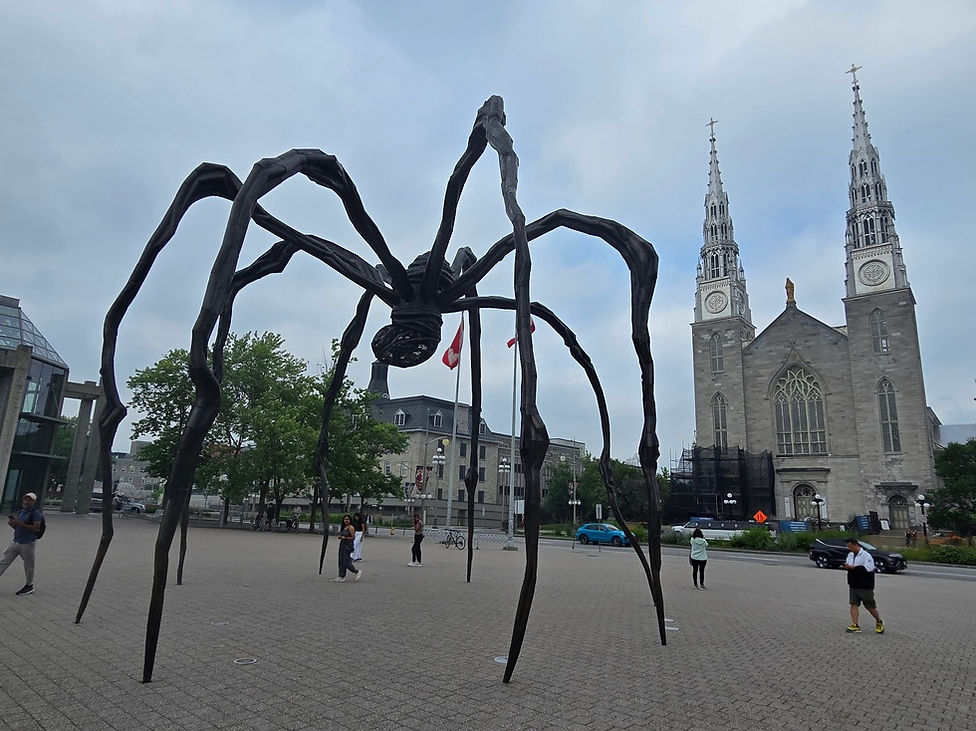
On our way back to downtown Ottawa, we unexpectedly encountered another local celebrity: the massive *Maman* spider sculpture. 🕷️ This giant sculpture by Louise Bourgeois—with its long legs and an egg sac beneath its abdomen—looks both eerie and mesmerizing, especially set against the backdrop of Notre-Dame Cathedral. It is truly a unique landmark of the Canadian capital; after the waterfall, the groundhogs, and the parliamentary rituals, Ottawa surprised us once again!
I decided to crawl right underneath the female spider—they say it’s always safer under a big monument! 😄 Though, given the size of her eggs, I wouldn't want to find out who’s really in charge here. 🕷️

We once again discovered something in Ottawa we knew absolutely nothing about—two massive mirrored towers near the Archives of Canada. While a window washer on a lift diligently polished the glass facade, we admired how the towers reflected the sky and the surrounding landscape. The view of the Ottawa River from there was simply magnificent—sometimes the most interesting places are found entirely by chance.

And there’s Gatineau—a city on the opposite bank of the Ottawa River that, from here, looks almost like an extension of the capital. But the most interesting part is that it’s no longer Ottawa, or even the province of Ontario, but the neighboring province of Quebec. It turns out that simply by looking across the river, we’re already gazing into a different part of Canada! Interestingly, Ottawa and Gatineau form a single metropolitan area, even though they are separated by both the river and a provincial border. That’s Canadian geography for you: cross a bridge, and you’re in a different Canada.

Near the Alexandra Bridge, we spotted a rather unusual type of tourist transport—an amphibious bus carrying passengers, calmly making its way along the Ottawa River. 😄 At first, it looks like an ordinary sightseeing bus, but then it suddenly drives right into the water and continues the tour along the river. That’s exactly why we love traveling—you never know what you might encounter around the next bend!

And here is a monument to a massive bolt of lightning called *One Hundred Foot Line*. ⚡️ It was installed in Ottawa to commemorate a century of electricity history and the way electric power has transformed our lives. Standing beneath this "lightning bolt," I find myself thinking: the main thing is not to get mistaken for a lightning rod! 😄

And here, I unexpectedly ran into Hemingway himself—though, for now, only on the wall. 📚 It feels like Grandpa and I would have plenty to talk about, but some topics are too personal to share on my blog.

Then we encountered Queen Victoria—one of the most important figures in Canadian history. It was she who, in 1857, selected Ottawa as the capital of the then-Province of Canada, putting an end to the rivalry among several cities vying for the title. The choice was not the most obvious one: Ottawa was situated roughly halfway between Montreal and Toronto, right on the border between the country's English- and French-speaking regions. Later, this very compromise helped Ottawa maintain its special status within Canada. Beside Victoria stands a lion—a symbol of British power and Canada’s ties to the British Empire. And just like that, a single royal signature determined the location of Canada’s capital today.

After spending a few days exploring the capital, it was time to shift gears from politics and history to music—we headed to Bluesfest 2026. It is a major summer music festival in Ottawa where artists spanning a wide range of genres—from blues and rock to pop and hip-hop—perform on multiple stages over the course of ten days. Consequently, the name "Bluesfest" has long since ceased to fully reflect the festival's musical lineup. On our way to the concert, we walked through Chinatown—a vibrant district with an atmosphere completely distinct from the rest of the city. We were greeted at the entrance by a colorful gate that made it immediately clear: a little slice of Asia begins right here in the heart of the Canadian capital. Ottawa’s Chinatown emerged back in the 19th century, and today it is a blend of Chinese, Vietnamese, Korean, and other Asian cultural influences.

A few steps into Chinatown, and we found ourselves surrounded by buildings with bright signs in Chinese. It’s quite an unusual sight for Ottawa: it’s still Canada, of course, but it feels as though you’ve been whisked away somewhere very far off for a moment. 😄

Well, here we are—Bluesfest 2026 is right before us, bringing with it a huge sense of anticipation for what’s about to begin! 🎶 After all the walking around Ottawa, it’s finally time for the music, and we’re ready to soak up the experience to the fullest!

We were struck by the size of the crowd at the entrance—it seemed as though all of Ottawa had decided to head to Bluesfest at the same time. Yet, the security check was surprisingly relaxed and nowhere near as rigorous as at many of the concerts we had attended in Ukraine. What surprised us most, however, was that we could freely bring our own food and water into the festival grounds. This was unusual for us; rules regarding this are typically much stricter at large music events.

The first big star of our evening at Bluesfest was Shaggy—and for me, it was a particularly long-awaited moment. I love reggae, and Shaggy is one of those artists whose songs you recognize from the very first seconds. Born in Jamaica and having shot to fame with hits like "Boombastic" and "It Wasn’t Me," he succeeded in making reggae popular far beyond Jamaica's borders. So, seeing him live on stage at Bluesfest in Ottawa was exactly what we had come for!

And then the moment arrived—Shaggy took the stage, and the crowd absolutely erupted! 🎶 From the very first seconds, a familiar rhythm kicked in that made it impossible to stand still—you just wanted to dance and sing along to every song. These are the moments that make going to festivals worth it: the music, the massive crowd, and the pure thrill of a live concert!
Here it is—the face of someone who’s just had their fill of pure musical bliss! 😄 Shaggy is on stage, thousands of people are all around, and my mind is filled with nothing but reggae and my favorite tunes. You just want to freeze moments like this and keep them forever.

And when it had grown fully dark, the evening’s main star—Gwen Stefani—appeared on stage. By then, the crowd had swelled even further; it seemed as though half of Ottawa had gathered for this very concert. I was particularly eager to hear "Don’t Speak"—one of the true anthems of my generation, a song impossible to listen to without stirring up romantic memories. Of course, Gwen’s hits go far beyond that: "Hollaback Girl," "Rich Girl," "The Sweet Escape," and her No Doubt tracks have long since become part of pop and rock history. And so, there we stood in the massive crowd in front of the stage, waiting for those first familiar notes to ring out.

And now—the very moment I’ve been waiting for all evening: Don’t Speak. ❤️
On the third day, we continued exploring Ottawa—the city clearly wasn't ready to let us go just yet. We stopped by the drawbridge on the Rideau Canal and waited for it to begin its daily operation. It was fascinating to watch the bridge rise right in the middle of the city to let boats pass through, while drivers waited patiently for the vessels to clear and the bridge to close again.

And so, the time has come to say goodbye to Ottawa—in just three days, we managed to make the most of our visit to Canada's capital. We saw Parliament and the Changing of the Guard, strolled along the Rideau Canal, discovered a waterfall, and even met some local groundhogs. Then came the music—Shaggy and Gwen Stefani—making for what was arguably the perfect finale to the trip. Ottawa surprised us with how effortlessly history, nature, culture, and modern life coexist here. Thank you, Canada's capital—it was fantastic!

If you liked our report, please share it with your friends.
And if there is something we can do better in the next article, then let us know in the comments. Subscribe to this link to be the first to receive fresh travel reports, and be sure to travel!
Thank you for reading and hope you subscribe!


